









Pronouns Types and examples – Know more
Pronouns
Classification of pronouns-
Pronouns are generally classified into nine categories.
1) Personal Pronouns.
2) Emphatic Pronouns.
3) Reflexive Pronouns.
4) Demonstrative Pronouns.
5) Indefinite Pronouns.
6) Distributive Pronouns.
7) Relative Pronouns.
8) Interrogative Pronouns.
9) Exclamatory Pronouns.
1) Personal Pronouns.
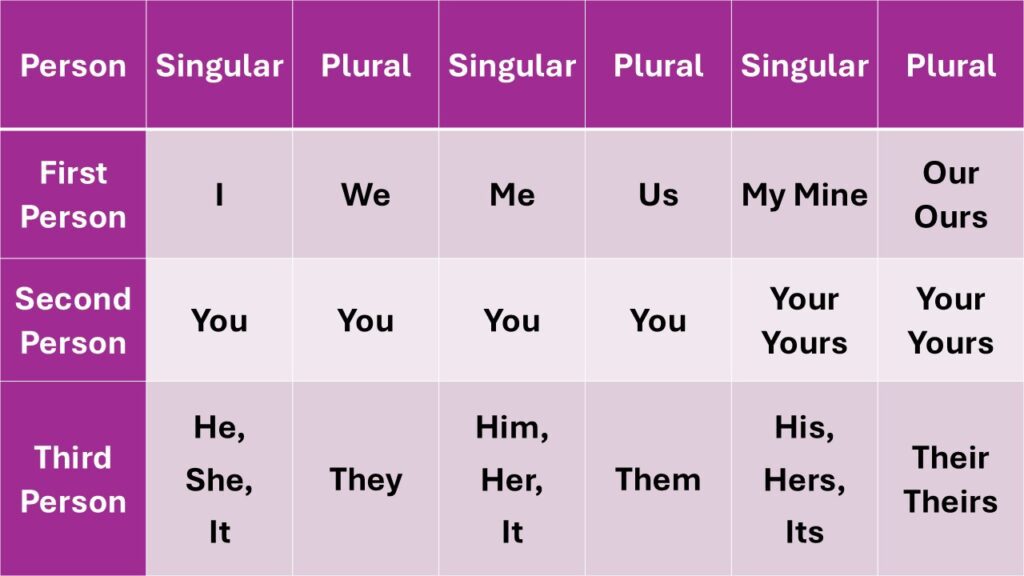
Personal Pronouns stand for the three persons. They are First person, Second person and Third person.
A Personal pronoun has the same number, Gender and Case as its own.
A pronoun is in the nominative, objective or possessive case when used in a sentence.
Table of personal pronouns-
Remember-
| The first person – | the speaker. |
| The second person – | the one spoken to |
| The Third Person – | the one spoken about. |
Words like ‘My, our, your, her, and their’ also function as possessive adjectives.
e.g.
a) He met her. (her- pronoun)
He took her books. (her- possessive adjective)
b) This is his watch. (Possessive adjective)
This watch is his. (Possessive Pronoun)
2) Emphatic Pronouns.
Emphatic pronouns are personal pronouns used for emphasis. The suffixes- self and selves are added to various personal pronouns for emphasis.
e.g.
I did it myself.
He himself cooked the food.
They themselves go there.
We ourselves completed the task.
You yourself can come to me.
3) Reflexive Pronouns.
When the action done by the subject affects or reacts or reflects upon the subject, they are called reflexive pronouns. The addition of self and selves to the various compound personal pronouns helps to produce a new meaning, quite different emphasis.
e.g.
a) We help ourselves
b) You help yourself.
c) They help themselves.
4) Demonstrative Pronouns.
Demonstrative pronouns are used to point out a thing or things commonly used in spoken language. The words ‘this. these, that and those’ are demonstrative pronouns when they stand alone.
e.g:
a) This is the place for you to meet him.
b) That I shall never see.
c) These are my friends.
Remember-
This, that, these, those etc. are demonstrative adjectives when they are used with a noun.
e.g.:
This car is green.
Aren’t those books my friend’s?
5) Indefinite Pronouns.
Indefinite Pronouns are used to denote persons or things in a general way. Words like all, some, few, everyone, everybody, nobody, many, none etc. are used as pronouns.
e.g.
a) All came to the party.
b) Some say that it is not true.
c) Nobody was there to help her.
d) One must not praise oneself.
6) Distributive Pronouns.
Distributive pronouns are used to denote persons or things one at a time. They are always used only in the singular form and the Verb following them must also be in the singular. The words each, either and neither are used.
e.g.
a) Each of these boys has separate views.
b) Each of the students received a certificate.
c) Either of the two books will be useful for the exam.
d) Either of you can go first.
e) Neither of them has arrived yet.
f) Each of the athletes was given a medal.
Remember-
Each, Either and Neither are sometimes used as adjectives.
e.g.:
i) Neither argument was true.
ii) Each man took his luggage.
iii) On either side was a horse.
(Here argument, man and side are nouns and they are modified by neither, each and either. So they function as adjectives.)
7) Relative Pronouns.
Relative pronouns are used to join together two sentences. Relative pronouns in English are ‘who, whom, whose, which, what and that’.
e.g.:
1) The queen lost a ring. It was made of gold.
The queen lost a ring which was made of gold.
2) The police caught a thief. He was stealing gold ornaments.
The police caught the thief who was stealing gold ornaments.
3) This is my friend. I met him yesterday.
This is my friend whom I met yesterday.
4) The tiger was captured last week. It has been sent to the Zoo.
The tiger that was captured last week has been sent to the Zoo.
5) I saw a man. His head was strange.
I saw a man whose head was strange.
Remember-
1) The relative pronoun ‘who’ generally refers to human beings and ‘which’ to animals and inanimate things.
2) The relative pronoun ‘that’ is often used for ;who’, ‘whom’ or ‘which’.
e.g.
This is the cycle that (= which) she bought.
Shyamrao was the best farmer that (= who) worked hard in his life.
The girls that (=whom) the teacher praised were very much pleased.
3) ‘Whom’ is generally used in formal English but it is common to use ‘who’ in ordinary conversation.0
e.g.
The man who (=whom) they caught was a thief.
The boy who (=whom) she fell in love with was very poor.
4) The relative pronoun also can be omitted.
e.g.
a) All the money that Anil had earned had been stolen.
All the money Anil had earned had been stolen. (‘that’a is omitted)
b) The rumour which we heard proved to be incorrect.
The rumour we heard proved to be incorrect. (‘which’ is omitted_
8) Interrogative Pronouns.
The relative pronouns who, whom, whose, which and what are used to ask questions then they are called interrogative pronouns.
e.g.:
a) Who is knocking at the door?
b) Whom did you meet in the class yesterday?
3) Whose is that book?
4) What are you planning to do this weekend?
5) Which of these novels do you like best?
Remember-
The Interrogative pronouns, whose, which and what are also be used as interrogative adjectives.
e.g.
a) Whose bike is that?
b) Which book will you take?
c) What information do you want?
In the above sentences bike, book and information are qualified.
9) Exclamatory Pronouns.
An exclamatory pronoun is a pronoun used as an exclamation.
e.g.
What a tragedy that you can’t meet him!
What a shock that you already told her!
Read More-

Do Solve the online test based on Indefinite Pronouns-
Indefinite Pronouns- Know more about them
An Indefinite Pronoun refers to non-specific beings, objects, or places. We use indefinite pronouns to refer to people or things without saying exactly who or what they are. We use pronouns ending in -body or -one for people, and pronouns ending in -thing for things:
e.g.
1) Everybody enjoyed the show.
2) He opened the door but there was no one.
3) She brings everything for her child.
List of some Indefinite Pronouns:
| Anybody | Everybody | Nobody | Somebody |
| Anyone | Everyone | No one | Someone |
| Anything | Everything | Nothing | Something |
| All | Every | Neither | Few |
| Any | Each | None | Both |
| One | Either | Many | Several |
Categories of Indefinite pronouns-
Indefinite pronouns can be divided into three categories based on whether they take a singular or plural verb:
1) Always singular:
anyone, everyone, someone, someone, anybody, somebody, nobody, each, one, either, neither, none, no one, everybody, another, little, less, much etc.
2) Always plural:
both, few, many, others, several, both, fewer etc.
3) Both Singular and plural (depending upon usage):
all, any, more, most, some etc.
(Here singular subject takes singular verb while plural subject takes plural verb.)
e.g.
i) Some of the money is needed by Anil.
ii) Some of the children are creating loud noise.
Remember-
a) We use a singular verb after an indefinite pronoun:
e.g.
1) Everybody brings books for donation.
2) Everything was ready for the event.
b) When we refer back to an indefinite pronoun, we normally use a plural pronoun:
e.g.
i) Everybody came to see the show. They stood up and clapped for the performance of the artists.
ii) I will tell all that dinner is ready. They have been waiting a long time.
iii) Everybody should mind their own business.
iv) Everyone chooses what they want to do.
About negative sense-
In negative clauses, we use pronouns with ‘no’. We do not use pronouns with ‘any’:
e.g.
Nobody came. (Do not write- Anybody didn’t come.)
We do not use another negative in a clause with nobody, no one or nothing:
e.g.
Nobody came. (Do not write- Nobody didn’t come.)
Nothing happened. (Do not write- Nothing didn’t happen.)
About showing possession-
We can add ‘s’ to an indefinite pronoun to show possession:
e.g.
1) He is waiting for someone’s call.
2) Is this anybody’s book?
Use of ‘else’-
We use ‘else’ after indefinite pronouns to refer to other people or things:
e.g.
1) If Sunil can’t come, we’ll ask somebody else.
2) I think this is somebody else’s shirt.
Using Question Tag-
Most of the indefinite pronouns take ‘they’ in question tag.
e.g.
i) Everyone was happy, weren’t they?
ii) Everyone should know it, shouldn’t they.
iii) Anyone is ready to do the work, don’t they?
iv) Somebody calls me, don’t they?
v) Nobody was present there, were they?
vi) Few came back, did they? (Few – negative meaning word)
vii) A few came back, didn’t they? (A few – Positive meaning word)
viii) All the students have passed the exam, haven’t they?
ix) None of them gives any response, don’t they?
Note that-
The pronoun of the indefinite subjects ‘something’, ‘everything’, ‘anything’, ‘nothing’, ‘little’, takes ‘it’.
e.g.
Something is happening there, isn’t it?
Nothing has been told, has it?
Little is wasted, is it? (Little – negative meaning word)
A little is wasted, isn’t it? (A little – positive meaning word)
Read More-
Plural forms of nouns
1) Most singular nouns form the plural by adding ‘-s’.
e.g.
| boat | boats |
| cat | cats |
| river | rivers |
| car | cars |
| house | Houses |
| book | books |
| bird | birds |
| pencil | Pencils |
2) A singular noun ending in ‘s, x, z, ch, sh’ mostly makes the plural by adding ‘-es’.
e.g.
| bus | buses |
| wish | wishes |
| pitch | pitches |
| box | boxes |
| church | churches |
| wish | wishes |
| match | matches |
| fox | foxes |
3) There’s one exception to this rule. If the ‘-ch’ ending is pronounced with a ‘k’ sound, add ‘-s’ rather than ‘-es’:
e.g.
| stomach | stomachs |
| epoch | epochs |
4) A singular noun ending in a consonant and then ‘y’ makes the plural by dropping the ‘y’ and adding ‘-ies’.
e.g.
| penny | pennies |
| spy | spies |
| baby | babies |
| city | cities |
| daisy | daisies |
| berry | berries |
| activity | activities |
5) With nouns that end in a consonant or a single vowel plus ‘-f or -fe’, change the ‘-f or -fe’ to ‘-ves’:
e.g.
| knife | knives |
| half | halves |
| scarf | scarves |
6) Nouns which end in two vowels plus ‘-f’ usually form plurals in the normal way, just add ‘-s’:
e.g.
| chief | chiefs |
| spoof | spoofs |
7) Nouns ending in ‘-o’ can add either ‘-s or -es’ in the plural:
e.g.
| solo | solos |
| zero | zeros |
| echo | echoes |
| hero | heroes |
8) Those which have a vowel before the final ‘-o’ always just add ‘-s’:
e.g.
| studio | studios |
| zoo | zoos |
| embryo | embryos |
9) Here’s a list of the most common nouns ending in ‘-o’ that are always spelled with ‘-es’ in the plural:
e.g.
| buffalo | buffaloes |
| domino | dominoes |
| echo | echoes |
| embargo | embargoes |
| hero | heroes |
| mosquito | mosquitoes |
| potato | potatoes |
| tomato | tomatoes |
| torpedo | torpedoes |
10) Here are some of the common nouns ending in ‘-o’ that can be spelled with either ‘-s or -es’ in the plural:
e.g.
| mango | mangos or mangoes |
| memento | mementos or mementoes |
| motto | mottos or mottoes |
| tornado | tornados or tornadoes |
| volcano | volcanos or volcanoes |
11) Plurals of foreign nouns
The plurals of words which have come into English from a foreign language such as Latin or Greek often have two possible spellings: the foreign plural spelling and an English one.
e.g.
| Word | Foreign word plural | English plural |
| antenna | antennae | antennas |
| appendix | appendices | appendixes |
| cactus | cacti | cactuses |
| curriculum | curricula | curriculums |
| formula | formulae | formulas |
| index | indices | indexes |
| terminus | termini | terminuses |
| thesaurus | thesauri | thesauruses |
| vortex | vortices | vortexes |
Note that there are a few nouns which have come into English from Latin which should always form their plural in the Latin way.
e.g.
| alga | algae |
| alumnus | alumni |
| larva | larvae |
12) Irregular nouns
e.g.
| woman | women |
| man | men |
| child | children |
| tooth | teeth |
| foot | feet |
| person | people |
| leaf | leaves |
| mouse | mice |
| goose | geese |
| half | halves |
| knife | knives |
| wife | wives |
| life | lives |
| elf | elves |
| loaf | loaves |
| focus | foci |
| fungus | fungi |
| nucleus | nuclei |
| syllabus | syllabi or syllabuses |
| thesis | theses |
| crisis | crises |
| phenomenon | phenomena |
| criterion | criteria |
| datum | data |
| apex | apices |
| curriculum | curricula |
| datum | data |
| focus | foci |
| series | series |
| vita | vitae |
| index | indices |
| ellipsis | ellipses |
| codex | codices |
| alumni | alumnae |
| ox | oxen |
| oasis | oases |
| larva | larvae |
| diagnosis | diagnoses |
| analysis | analyses |
13) Some nouns have the same form in the singular and the plural.
e.g.
| aircraft | aircraft |
| fish | fish |
| deer | deer |
| sheep | sheep |
| species | species |
See More –


good